Last month, a client in the creative-products business came to me wanting a set of "city illustrations with an Eastern temperament." The budget was generous. There was only one condition: the work had to be commercially usable, and the license had to be clean.
I said yes without blinking. Generate images? Fire up Midjourney, write a prompt, deliver in two hours.
Then he added: "Did you draw these, or were they AI-generated? If they're AI, who owns the copyright? Our legal team needs documentation."
I froze.
Three years in this trade, and that was the first time the question hit me head-on. I'd always treated "who owns AI copyright" as an internet argument starter — something far away. But the moment it became a clause in a contract, a line in a legal email, I realized I had no answer.
So I spent the next three months reading every ruling, report, and terms-of-service I could find. This isn't legal advice. It's the full record of one person, caught off guard, doing homework.
It starts in August 2022. At the Colorado State Fair's annual art competition, first prize in digital arts went to a piece called Théâtre D'opéra Spatial — an image generated with Midjourney.
Jason Allen insisted it was his work: he wrote the prompt, iterated 80-plus times, and composited layers in Photoshop. The judges accepted it. The art world erupted. Some called it an insult to painters; others said the rules never banned AI, so why not.
The real fight came later. Allen applied to register the image with the US Copyright Office — and initially it passed. September 2022, the image was on the books. Then in February 2023, during a routine review, the Office spotted the application plainly stating "generated with Midjourney." They started a cancellation proceeding and asked him to explain. He rolled out his case: 80-plus prompts, layer compositing, careful selection. The Office wasn't moved: writing prompts is "instruction," using Photoshop is "editing" — but the image's expression itself was decided by Midjourney. Your contribution is negligible. Not authorship.
September 2023, the final word came down: rejected.
Social media that day was a war zone. Some cheered — a victory for art, why should AI claim a human's prize? Others mourned — a step backward, why doesn't the progress of tools count as work? The shouting settled nothing. What settled was the rule: at the level of the image itself, the US Copyright Office does not recognize AI.
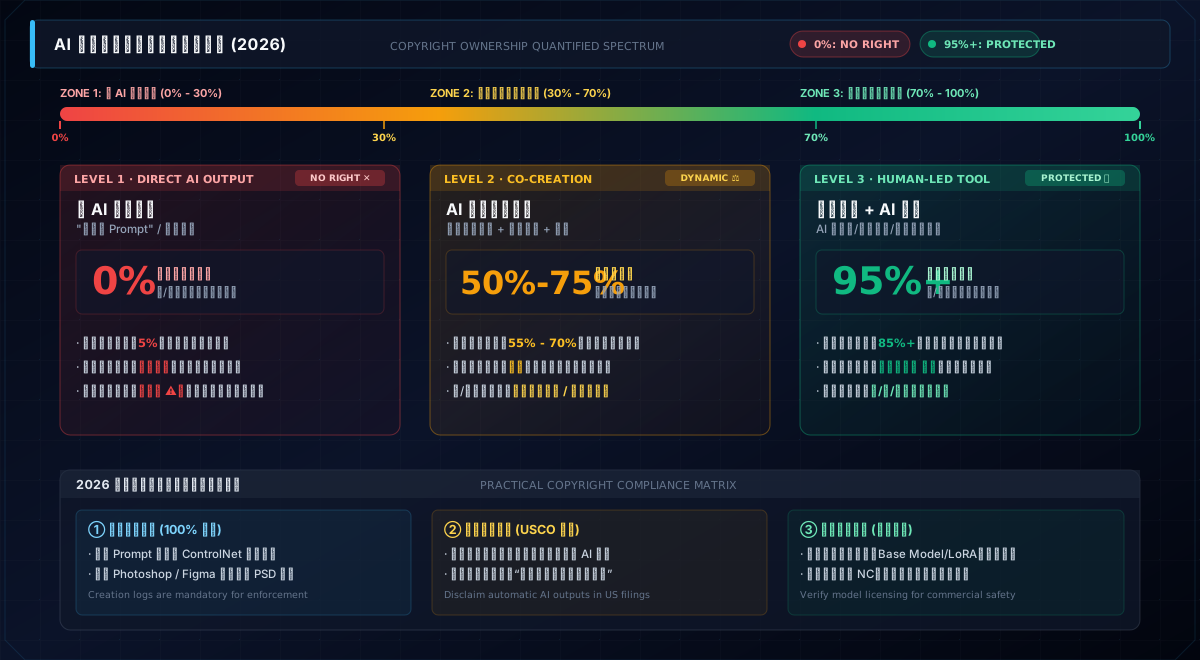
That case drew a plain dividing line: copyright sits on the side that actually "drew" the pixels. AI-generated pixels have no author in the eyes of the law. Standing beside it saying "a little more to the left" or "make it red" makes you a director, not an author. It's like telling a painter "paint a space opera" — the painter owns the painting, not you.
America had just closed the door. China opened a window.
In November 2023, the Beijing Internet Court ruled on a case the press called "China's first AI-generated image copyright case." The plaintiff generated an image with Stable Diffusion, crafted prompts, iterated on parameters, and posted it on Xiaohongshu. The defendant used it without permission. The plaintiff sued.
What won the case was the creative process the plaintiff laid out in court: how the prompt was written, revised, how the parameters were tuned, why this one was kept out of dozens of candidates — twenty-plus prompt records, neatly lined up as evidence. The judge saw not a person who "pressed a button," but someone who refined the work the way any traditional creator does.
Verdict: the image constituted a work protected by copyright law, and the infringement stood. The reasoning in one line: the plaintiff's design, selection, and arrangement of prompts reflected human intellectual input and originality. AI is a tool; tools don't express themselves. The person behind the tool is the author.
The damages were modest — the symbolism mattered far more than the money. The court stated plainly that an author who invests "original intellectual activity" in AI output gets it protected as a work. That characterization is worth more than any payout. After the ruling, teams building AI tools across China were quietly sharing it: "guess we should remind users to keep records now," "looks like AI-art freelancers should learn to document their process." One ruling changed an industry's habits. That's what precedent is for.
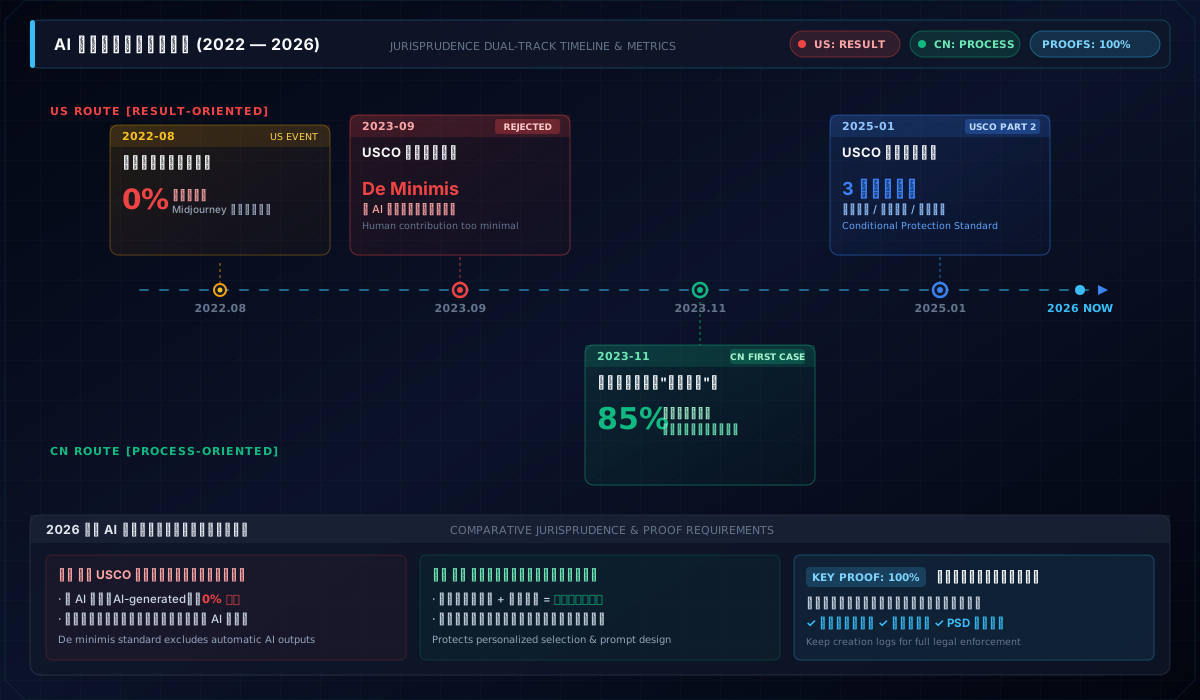
Same scene, two jurisdictions, opposite answers. America: the AI-generated image itself has no human author, so its core isn't protected. China: as long as human intellectual input is sufficient, the output is the human's expression, and AI is just a brush.
My first reaction reading both was: aren't these fighting each other? After a night of thinking, no. Both answer the same question — how much "human" is in it — with different rulers. America's bar for "human contribution" is so high that even that award-winning image didn't clear it. China's "originality" bar is lower: as long as your prompt process involves real selection rather than copying, you pass.
On January 29, 2025, the US Copyright Office released Part 2 of its AI report, dedicated to the copyrightability of generative AI outputs. It remains the most systematic official statement globally.
It didn't draw one hard line. It offered layers:
The report also walked back through the flip-flops. In 2023, Zarya of the Dawn — a comic whose illustrations were Midjourney outputs — was first registered in full, then partially revoked once the Office discovered the illustrations were AI-generated, keeping protection only for the text and overall arrangement. The author was upset: I selected every image, I wrote the story, why don't the illustrations count? The Office was candid: the illustrations were "generated," so that part has no copyright; but the book as an arranged work is yours. Even the officials were feeling their way.
Then there's the extreme case: Thaler had an AI system "autonomously" generate an image and filed with "AI as author." Rejected, appealed all the way to court. The judge's conclusion: copyright law protects only human authors; machines aren't authors. It reminds me of that famous monkey — the monkey-selfie case ruled animals can't own copyright either. From monkeys to AI, the logic runs in one line: the author must be a "person."
The nights I spent on that report, I was up till 3 a.m. Ninety-plus pages of PDF, half legalese and half case citations, grinding through them against a translator — having to look up Latin terms like "de minimis," which just means "negligible." I got into a habit: after every section, write a two-line summary in my own words, or I'd forget everything by morning. Looking back, those summaries became the skeleton of this article. Around the same time I took a friend who practices IP law out for dinner. He listened to my confusion, picked up a piece of meat, and said slowly: "Just remember one sentence — copyright law cares about exactly one thing: how much of the work is the human's." Crude, but better than the whole stack of rulings.
Laws feel distant; terms of service feel close. Opening Midjourney, OpenAI, and Adobe Firefly's licensing agreements, I found the real trap most creators trip on.
Midjourney paid users: generated images may be used commercially, but whether copyright transfers to you — the official wording grants "ownership to the extent permitted by applicable law." Notice those six words. They punt back to copyright law, i.e., the cases above.
OpenAI (DALL·E family): ownership transfers to you "to the extent permitted by applicable law." Adobe Firefly differs — it explicitly marks output as commercially usable, because its training data comes from Adobe's licensed asset libraries, giving it more confidence.
There's a layer people miss: training data itself may infringe. Your AI image may carry a photographer's composition or an illustrator's stroke. If training data is ever ruled infringing, could generated images be implicated? There's a wave of US lawsuits against Stability AI and Midjourney over training data right now, and 2026 will likely produce pivotal rulings. That's a sword hanging over every AI image, and no ToS can fix it.
The EU hasn't been idle either. The AI Act, passed in 2024, is rolling out in phases from August 2025 — and one provision hits creators directly: AI-generated content must be labeled. Publish an AI image in the EU market, and people must be able to tell it was AI-made. China was actually earlier: the 2023 Interim Measures for Generative AI Services already required AI content to carry a label that doesn't interfere with use. Labeling isn't a bad thing. It drags "AI-generated" out of the shadows, and ironically makes genuinely human-augmented work easier to see and credit.
After three months of reading, I wrote myself a practical playbook — and sent it to that client.
First, commercial use and copyright are two different things. Don't merge them. Whether an AI image is commercially usable depends almost entirely on the platform ToS — paid Midjourney, Firefly, and paid DALL·E are all fine for commercial work. But whether it's protectable — registerable, enforceable — is a copyright question, and that depends on human input. Commercial use ≠ copyright. Keep those two sentences separate.
Second, if you want copyright, keep the "human" evidence. If you want an AI image to support a future authorship claim, start building these three habits now:
The 2025 Copyright Office report boils down to one sentence: prove you did the work of an author, not just a conductor. Chinese courts weigh the process record too — in the Beijing case, the plaintiff won on exactly that stack of prompt drafts.
Third, read the platform ToS before quoting a price. Before delivering images to a client, screenshot the ownership section — which platform, which paid tier, what the ToS says — and send it over in black and white. Don't wait for legal to ask. I learned this the hard way once: a client tried to register an AI image as a trademark and got rejected — not for copyright reasons, but because the image was too "generic" and lacked distinctiveness. Another trap: AI output tends to look alike, so be extra careful when using it as trademark material.
Fourth, watch the big 2026 cases. The US training-data lawsuits, the EU AI Act's implementation details, and whether China produces new AI copyright rulings — all of this is moving. My read: over the next two years, "can AI images be used commercially" will get clearer, while "do AI images have copyright" will stay fuzzy, because law always lags the tools.
Speaking of which — a friend's bad luck. He sells AI-generated wallpapers online, a few hundred orders a month, going fine, when suddenly the platform notified him: one image was reported as stolen and taken down. He was baffled — I made this in Midjourney, how is it stolen? Turns out the complainant had a "similar image" and suspected him. He appealed. The platform asked him to prove the image was his creation. He had nothing — prompts deleted, no records. He swallowed it. After that, he started archiving every image he sells: prompt, parameters, generation timestamp, screenshotted. His words: "I used to think keeping records was for the courts. Now I know it's for covering your own back."
Back to that client. I compiled the whole framework into a two-page note and sent it over, with the generation records attached.
He replied: "Fine, that's clear enough. Contract signed."
That moment, I realized being caught off guard isn't the shame — papering over it is. Nobody is born knowing how AI copyright works, but anyone who earns a living from it should spend the time to understand it: at least the cards in your hand, and the rules on the table.
Note: This article is a personal research note, not legal advice. For specific cases, consult a licensed attorney.